Graveyard Keeper is one of those games that, at first glance, seems like a cozy pixel life sim. But instead of a farmhouse, you are left with a run-down medieval graveyard. This means you have to prepare corpses, expand graves, gather resources, manage a church, and even do some farming. Throw in dark humor and some highly questionable ways to squeeze a little extra profit out of the dead.
Summary
The first game in the series dates back to 2018 and received several DLCs in the years that followed. In September 2026, Lazy Bear Games finally returned with Graveyard Keeper 2. The sequel offers much more than just “more graveyard.” Entire production layers are automated, you rebuild a town, and you even send undead armies into battle.
Graveyard Keeper – Stardew Valley in a cemetery
Graveyard Keeper was developed by Lazy Bear Games and published by tinyBuild. The game originally launched in 2018. But the core concept of the game was extraordinary. Instead of landing in a standard pixel farming life sim, you drop into a medieval world and take on the role of a graveyard keeper.
Your actual goal is to find a way back home after ending up in this world. But until then, you must come to an arrangement with the local populace and rebuild the dilapidated cemetery.
As the graveyard keeper, you regularly receive new corpses from a talking donkey, which are first sent to the morgue. There, you can examine and modify the bodies. Afterward, you can decide whether the corpse is buried, processed further, or put to another use.
At the same time, graves must be repaired and upgraded, as gravestones and fences increase the quality of the cemetery. A better graveyard unlocks further progress in the game.

But Graveyard Keeper offers more than just a cemetery. Before long, you unlock numerous other activities in the game, such as farming, woodworking, stone carving, metalworking, alchemy, cooking, research, as well as church management and sermons.
Consequently, the game increasingly evolves into a management RPG. While the graveyard remains the focal point, it is not the only system. Many of the game’s production chains are interconnected.
Corpses, organs, and profit – why Graveyard Keeper stayed in our memory
The most striking aspect of Graveyard Keeper is its approach to death. Corpses are not merely people to be buried as respectfully as possible. They are a component of the economic system. Organs and other body parts can be extracted, altering the corpse’s quality, which in turn is relevant to the graveyard’s value. In this way, you optimize the dead almost like any other resource.

Efficiency often takes precedence over piety. Not every corpse necessarily has to end up in the cemetery. Certain resources can be harvested from the bodies and utilized elsewhere. Dealing with meat, in particular, showcases the game’s dark humor, as it can be sold and turned into food.
Furthermore, the game features absurd NPCs with unique dialogue and storylines. Corrupt or self-serving characters, religious satire, bureaucracy, and questionable business ventures are commonplace. Your own character is not a traditional hero, but rather someone who involuntarily arrived at the cemetery and wants to progress as efficiently as possible to return home.
The pixel art style softens the harshness of many of the game’s structures. Despite the abundance of corpses, organs, and blood, Graveyard Keeper does not feel like a horror game. Instead, grotesque humor takes center stage. Peaceful music, farming, and crafting collide with utterly absurd situations. Exactly this contrast makes Graveyard Keeper unmistakable. Rather than focusing on a relationship, a village community, or a beautiful farm, your objective is to manage a profitable medieval cemetery.
Zombies slowly turned manual labor into automation
Graveyard Keeper 1 can be incredibly labor-intensive, especially in the beginning. Many resources must be gathered personally. You frequently have to walk long distances and expend energy to collect wood, stone, ore, and crops.

Some quest givers, for instance, only appear on specific days, leading to a lot of time spent waiting for NPCs and gathering materials. You also have to figure out many of the connections yourself.
With the free Breaking Dead update, zombies took on a much more prominent role. These zombies can handle repetitive tasks such as resource mining, farming, transportation, and even parts of the production process. With this, Lazy Bear Games at least partially resolved one of the base game’s biggest issues.
Over time, several paid DLCs were also released. Stranger Sins introduced a tavern and additional background stories for the townspeople. Game of Crone added a major new questline and a refugee camp. The final DLC, Better Save Souls, further expanded the systems surrounding corpses and souls. The DLCs transformed Graveyard Keeper into a significantly more comprehensive game, and many of the new features became highly relevant for the eventual sequel.
Graveyard Keeper 2 Turns the Graveyard into an Entire City
Graveyard Keeper 2 was announced in 2026 and released on September 22, 2026. The game was once again developed by Lazy Bear Games and published by tinyBuild. It is available for PC, PlayStation, Xbox, and Switch, spanning both old and new generation consoles.
In the second installment, you do not simply manage a larger graveyard; the responsibilities of the Keeper have expanded significantly. You are now a Grand Inquisitor, as the entire kingdom is currently facing a zombie problem.

In the game, the city becomes the new central hub, with rebuilding the town serving as a crucial aspect of the experience. Graveyard Keeper 2 transforms the title into a much larger management system. You must renovate and upgrade the facilities in the city to unlock new mechanics and shops.
The problems of the residents are once again solved as profitably as possible. The developers explicitly describe the concept as a combination of city-building and profit-making. The Keeper evolves from a small graveyard owner to the manager of a much larger economic system.
Nevertheless, the graveyard remains a core part of the game. Corpses still need to be processed and buried. Gameplay features such as farming and resource gathering are also retained. Plants, animals, and human remains are utilized for production once more. These systems are not replaced; rather, a significantly larger game has been built around them.
Graveyard Keeper 2 Relies Heavily on Automation
In the first game, production chains were already a central component, and they are expanded considerably in the sequel. You build machines and combine various production steps. However, the goal is no longer to perform every task manually. Ideally, you will automate your entire production process.
To achieve this, zombies return as a workforce. In the predecessor, they were introduced relatively late, requiring a lot of manual labor beforehand. In the second part, however, they are a fundamental part of the core concept from the start. Undead minions can be deployed for automated production workflows.
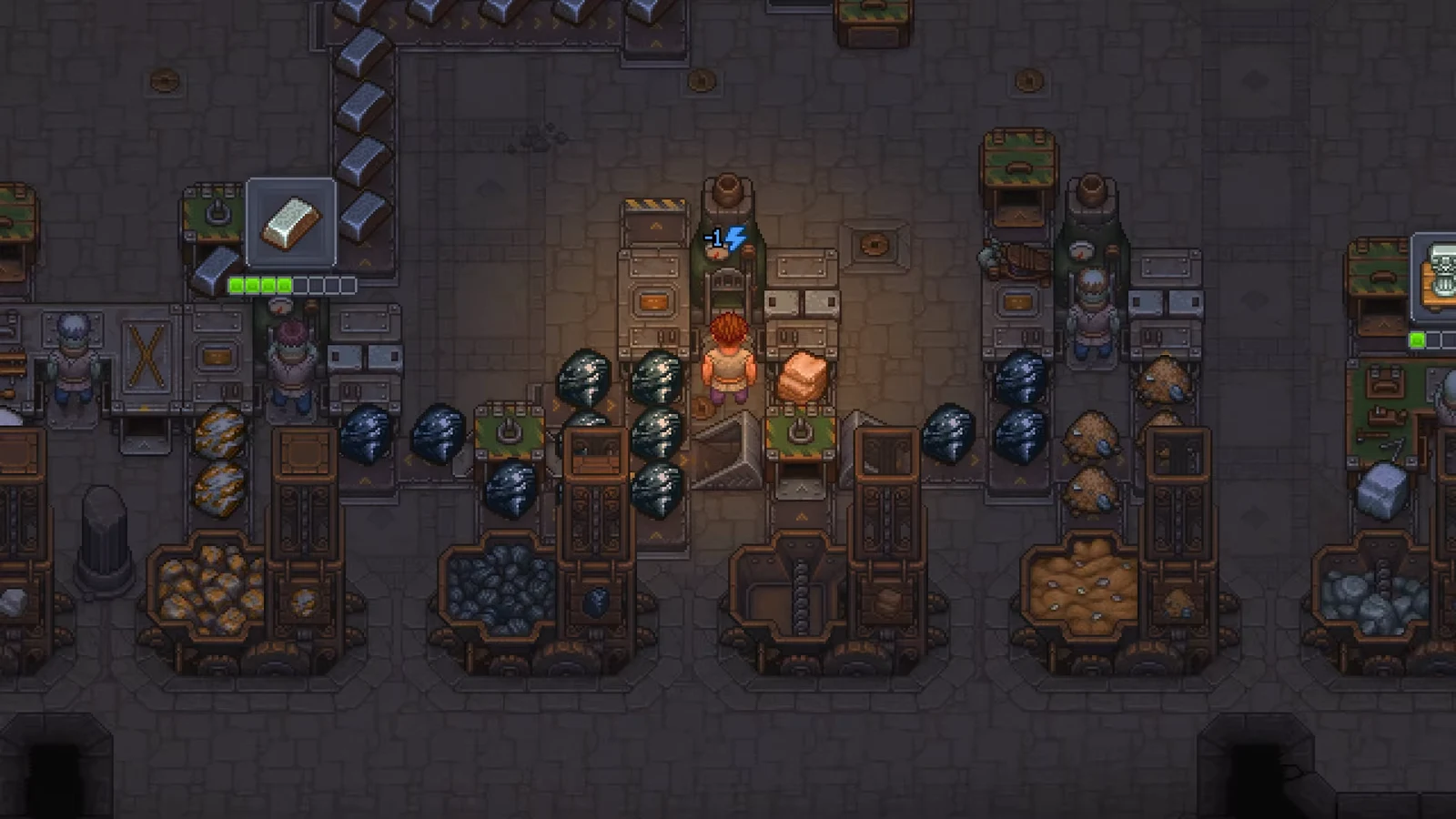
As a result, your enterprise grows without the need for you to gather every resource yourself. Lazy Bear Games describes this as a large-scale operation driven by zombie automation. This clearly demonstrates an evolution of the late endgame mechanics from the first title.
Automation also means focusing more on optimization. You must plan production routes, place machinery logically, ensure resource supply, and assign zombies appropriately. Instead of simply unlocking new recipes, you increasingly optimize an entire production network.
This gives the game a stronger factory automation approach. However, the familiar life simulation elements are fully retained. It is precisely this blend that continues to distinguish the sequel from classic factory building games.
From Graveyard Keeper to Commander – Zombies Now Go to War
Perhaps the most significant change compared to the first game is the much stronger focus on combat. The kingdom you reside in is threatened by a zombie apocalypse. Ironically, the Keeper responds to this zombie apocalypse with more zombies. As Grand Inquisitor, you lead your own undead army into battle.

This means zombies are no longer just workers; they are also fighters. As Grand Inquisitor, you must equip, arm, and train your troops. This requires crafting weapons and armor. In this way, production and combat are directly intertwined. The workshops do not merely provide goods and building materials; they supply your personal zombie army for the fight against the undead invasion.
In addition to troops, you can construct towers and fortifications, introducing prominent strategic elements to the game for the first time. The army does not serve merely as a new minigame; it is an integral part of the overarching objective to protect the kingdom from the apocalypse.
Conclusion – Graveyard Keeper 2 Exhumes the Classic Formula
Even in 2018, Graveyard Keeper was more than just a dark-humored Stardew Valley clone. While the graveyard was the center of the game, production, alchemy, farming, the church, and later zombie automation evolved it into an increasingly expansive management RPG. The unconventional handling of corpses and the blend of a cozy pixel aesthetic with macabre humor made the game unmistakable.
Graveyard Keeper 2 now picks up exactly where its predecessor left off with its later updates and DLCs. Instead of merely managing a graveyard, you rebuild an entire city, automate extensive production chains, and utilize zombies not only as workers but as an entire army. This transforms the original graveyard simulation into a substantially larger management game featuring factory and strategy elements, all without abandoning the beloved life simulation systems.
Download the Allkeyshop Browser Extension Free
For all the latest video game news, trailers, and best deals, make sure to bookmark us.
You can find all the best and cheapest online deals on CD keys, game codes, gift cards, and antivirus software from the verified CD key sellers on our store pages.
To not miss any news on Allkeyshop, subscribe on
Google News
.
MORE RELEVANT ARTICLES
PakarPBN
A Private Blog Network (PBN) is a collection of websites that are controlled by a single individual or organization and used primarily to build backlinks to a “money site” in order to influence its ranking in search engines such as Google. The core idea behind a PBN is based on the importance of backlinks in Google’s ranking algorithm. Since Google views backlinks as signals of authority and trust, some website owners attempt to artificially create these signals through a controlled network of sites.
In a typical PBN setup, the owner acquires expired or aged domains that already have existing authority, backlinks, and history. These domains are rebuilt with new content and hosted separately, often using different IP addresses, hosting providers, themes, and ownership details to make them appear unrelated. Within the content published on these sites, links are strategically placed that point to the main website the owner wants to rank higher. By doing this, the owner attempts to pass link equity (also known as “link juice”) from the PBN sites to the target website.
The purpose of a PBN is to give the impression that the target website is naturally earning links from multiple independent sources. If done effectively, this can temporarily improve keyword rankings, increase organic visibility, and drive more traffic from search results.
Comments are closed, but trackbacks and pingbacks are open.